We started by making use of what was left behind.
Sustainability isn't a discipline. It's a way of looking at what we already have — materials, knowledge, people, spaces, technology, and opportunities — and asking what else they can become.
01. The Physical Origin: Reclaim
In 2015, Nepal experienced a devastating 7.8 magnitude earthquake.
Instead of starting with a theoretical sustainability thesis or abstract corporate manifesto, we started with a direct, practical question: What can we do with what is already here?
From the rubble and discarded remnants, we constructed a physical space with our own hands:
This is not an origin story manufactured after the fact. It is the core DNA of Sustainability Lab: waste became walls, rubble became possibility.
02. The Living Platform: Connect
The physical space evolved organically into an active, self-sustaining community platform:
- A vibrant coworking space hosting researchers, builders, makers, and grassroots innovators.
- Nutri Kitchen, connecting locally grown nutritious food and regional food systems directly with the community.
- Poshan Agro and Kalpabrikshya, incubated and rooted within the physical space.
- Civic town halls serving as the official neighborhood gathering space for the Nursery Lane Tole Sudhar Samiti.
- Diverse interdisciplinary cohorts: hosting interns and collaborators spanning psychology students, trekking guides, tour guides, ceramicists, and environmental researchers.
“We don’t need your information. We need your knowledge.”
Information is passive data on a screen. Knowledge is lived experience, spatial intuition, and how materials actually perform in the real world.
03. The Planetary Lab: Experiment
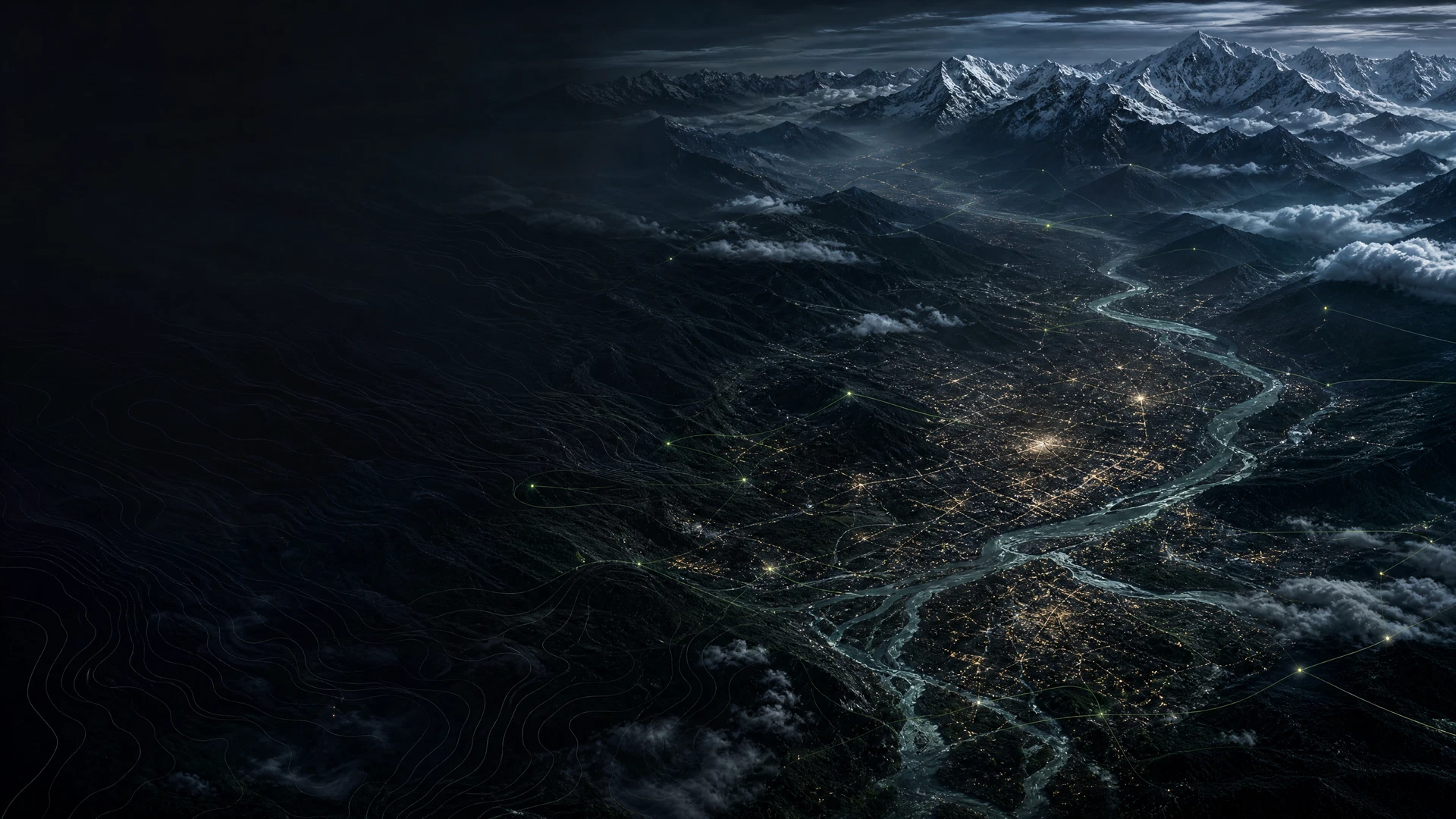
Today, we expand that founding inquiry to planetary scales: What can we build with the knowledge, technology, resources, and systems already around us?
We combine cutting-edge planetary computing with deep material science:
AI & Physics Models
Physics-informed neural networks simulating mountain hydrology, rainfall run-off, and hazard cascades before crises emerge.
Earth Observation Radar
Continuous synthetic aperture radar (Sentinel-1) and multi-spectral satellite streams tracking glacial lakes and forest canopies.
Bio-Composites & Craft
Transforming agricultural residues and fallen Sal leaves into structural architectural bio-materials through KĀRVA.
Local Community Wisdom
Grounding every computational prediction in the lived realities and traditional ecological wisdom of Himalayan communities.
Ready to build what comes next?
Collaborate on planetary platforms, material assays, or pilot deployments.